
Recognizing the seasonal trends of load volumes is essential for logistics managers who are responsible for seasonal flatbed tracking. In Pittsburgh, the city where various manufacturing sectors such as steel mills and advanced component factories are located, understanding when to increase or decrease the headcount can save time, cut expenses, and the most importantly improve customer satisfaction. This article reviews the practical way to track the seasonal trends of local manufacturing loads, implement volume forecasting tracking and adjust your fleet according to seasonal trends.
Getting to know the seasonal of Pittsburgh’s Manufacturing Sector
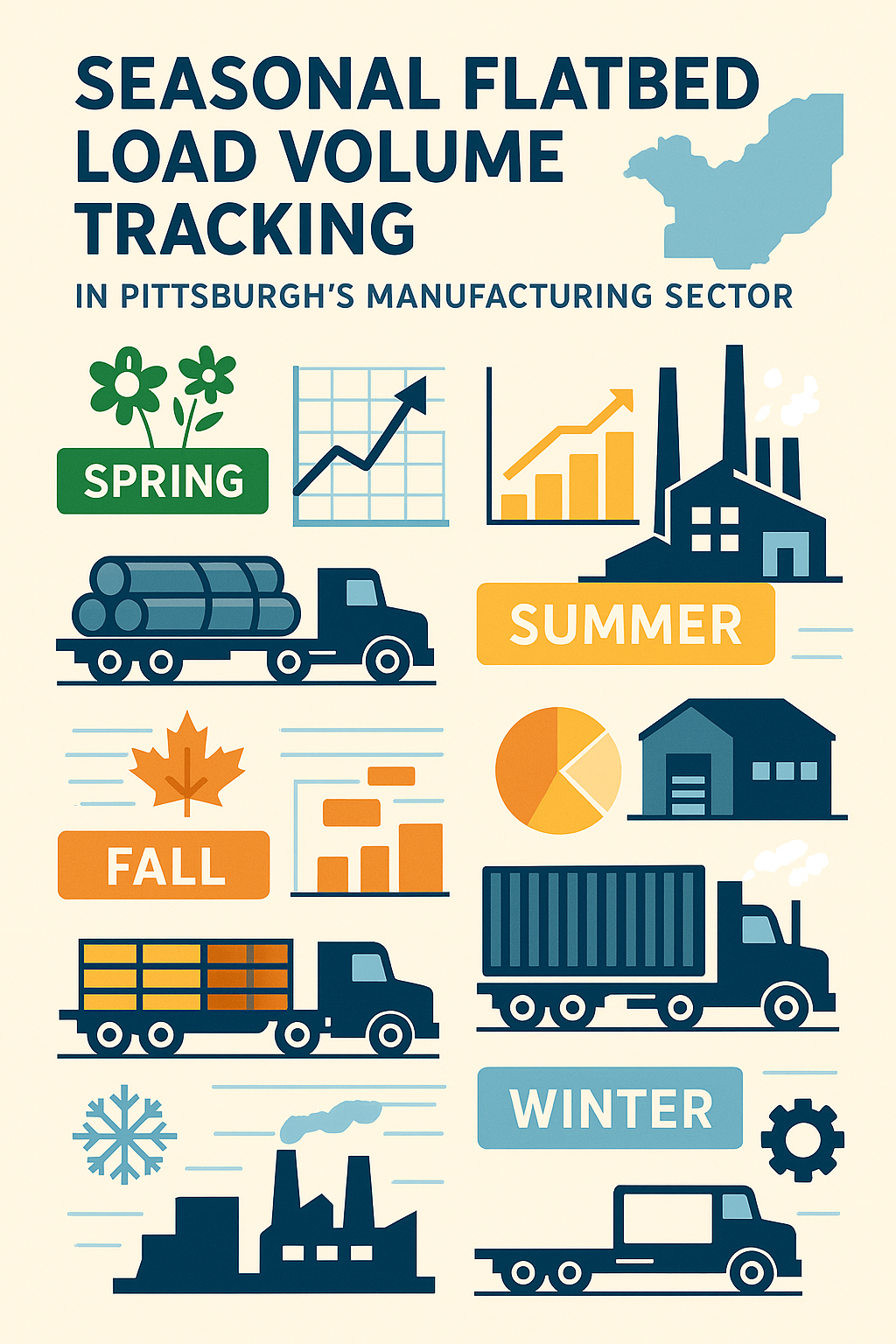
Before we delve into the marking of seasonal flatbeds and their associated Pittsburgh loads the reader should know that Pittsburgh’s manufacturing has a distinct production calendar that is affected by factor such as end-market demand and maintenance schedules of factories. Each plant’s spring ramp up of construction materials to holiday-driven consumer goods surges, and every season comes with the same attached peaks and lulls.
- Spring & Summer: Focus is on high demand for components needed for raw steel construction.
- Fall: The steady picture is resumed by agricultural equipment and energy infrastructure projects.
- Winter: The time of the year when plants are offline and maintenance is done causes the total volumes to drop.
Seasonal patterns (seasonal surge) can be recognized and scheduling can be done thusly. The data collected over time and the current bookings can be interpreted together to catch the possible seasonal surge. Backlog Monitoring, which is being constantly updated, is also useful — through it, shifts can be recognized earlier than expected whether it be a sudden backlog reduction indicating possible order cancellations or a backlog increase that brings in project starts.
Volumetric Forecasting and Tracking: The Key Metrics
The successful volume forecasting tracking is achieved with just a few selected essential metrics:
- Backlog Monitoring
The orders that are pending the shipment are tracked to give the needed insights on the workload and the possible bottlenecks. - Capacity Planning
Making sure the right number of trailers and drivers available is a guarantee that you do not overcommit or put unused resources to waste. - Fleet Staging
By equipping agreements for additional trailers that go close to a high-volume facility, you can react promptly if another order is suddenly raised. - Idle Time Reduction
Monitoring asset use hour and taking action to eliminate idle hours promotes fleet health and cuts down overhead.
The digitization of these key metrics into common dashboards allows dispatch teams and operational teams to work in unison, lessening manual errors and miscommunication delays.
Simple Corrective Seasonal Flatbed Tracking
- Dynamic Resource Allocation
Before a winter maintenance shutdown, distribute drivers and trailers to the area by slightly rotating them on longer work tasks. - Proactive Capacity Planning
A rolling forecast, which updates the driver schedule monthly based on the machine volume increase predicted by the plant, is a good Idea. When hiring, teaming with sub piles or others is a given. - Pipeline Visibility
Integrate your Transportation Management System (TMS) with plant ERP outputs so that every new order automatically triggers dispatch alerts and updates fleet availability. - Fleet Staging Near Key Hubs
For a high-volume facility, the dedicated staging of a reserve pool of trailers will help you to reduce the response time when a sudden order comes.
With these measures, you turn around your duties from firefighting reactively to conducting excellently.
Deploying the Technology for Fast Visibility
The modern equipment has clear benefits above others in seasonal flatbed tracking:
- ETA Forecasts
Technologies based on artificial intelligence check weather, traffic, and past year speed profiles to suggest a more accurate ETA that will in turn cut down on the truck’s insecure stay and improve customer trust. - Mobile Dispatch Alerts
Automated sms or Applaunch notifications will be sent to drivers before the loads are handed over to them which in turn will help in your plant get rid of unnecessary waits. - Interactive Production Calendars
Create a joint calendar with your production partners that contains planned downtimes, local holidays, and capacity constraints.
With the integrative connection between TMS and up-to-date plant schedules, you will gain total visibility of your operation ensuring total success when spikes are dramatically high.
Table: Quarterly Flatbed Load Volumes and Actions
| Quarter | Avg Loads/Week | Key Metric | Recommended Action |
| Q1 (Jan–Mar) | 120 | Backlog drop-off | Driver overtime; short-haul work |
| Q2 (Apr–Jun) | 180 | Seasonal surge | Pre-position 15% extra trailers; ramp up hiring |
| Q3 (Jul–Sep) | 165 | Fleet staging | Rotate trailers through maintenance hubs |
| Q4 (Oct–Dec) | 140 | Plant maintenance | Temporarily shift assets to regional cross-dock facilities |
This table provides a clear overview of the resource inflow and outflow while also informing staff of the exact action to take.

Idle Time Reduction and Fleet Staging Optimization
With downtime control, you are collecting much more than just a KPI. By performing these which can be seen as KPI´s really you can see the return on your bottom line. Firstly:
- Dynamic Staging Zones: Recognize problem areas during peak months and establish temporary staging zones accordingly.
- Cross-Docking Partnerships: Cross-dock warehouses with local partners for minor seasonal gaps, ensuring empty trailers.
- Driver Incentive Programs: Set goals to reward low idle times and motivate drivers to choose routes that avoid congestion at plants.
In the long run, these little things will accumulate into broader savings and much better running operations.
Plant Proximity and Resource Allocation
Proximity to key manufacturing hubs will cut down the dead miles and increase the speed of resolving the issues. To further increase plant proximity advantages:
- Geo-Fencing Alerts
As soon as a trucker enters a radius of two miles of a plant, it will be scheduled for the first load with it. - Smart Resource Allocation
Connecting your TMS to the real-time plant output, the truck drivers can be redirected to an alternate spot if the primary area is not available. - Staggered Shift Planning
Make arrangements with the plant manager on staggered loading periods that will help with reducing traffic congestion.
Your local staging and smart allocation can turn proximity into profit.

Working together with Carriers and Dispatch Alerts
Although in stand-alone fleets our manpower can accommodate a great part of the requirement, at the same time, the partnerships fulfill the gaps in extreme peaks. A good illustration is, for instance, teaming up with a carrier like HMD Trucking during your peak and working to cover that surge without absorbing significant overhead. Ensure that the third-party carrier is:
- Dispatch Alerts Integration: Discrete communication channels bring everybody along cohesive.
- Capacity Planning Guidelines: Activation triggers absent of vagueness.
- Performance Metrics: Control them like you do with your assets – track their ETAs, dwell times, and compliance standards.
With hybrid practices we get flexibility and control.
Summary
The task of tracking local manufacturing loads through seasonal cycles combines statement data, tactical shelving, and partnership execution. If you layer the volume forecasting tracking across every stage such as backlog monitoring, capacity planning, ETA forecasts, and fleet staging you will conquer the seasonal waves. Don’t forget shared production calendars, lower idle times, and dynamic resource allocation. Your flatbed network will not only go with the season but will also excel through them having these tricks in place.
FAQ
- In what way is seasonal flatbed tracking done?
Seasonal flatbed tracking is an activity of making adjustments by monitoring flatbed load volumes to suit the expected seasonal manufacturing demand. - How can backlogs support the forecasting of volumes?
Backlog monitoring gives an idea of the pending orders to the logistics managers, enabling them to forecast the requirements for capacity and to prevent possible bottlenecks. - What are the important measurements for volume forecasting tracking?
The main metrics consist of backlog monitoring, capacity planning, fleet staging, and idle time reduction. - How does dynamic resource allocation promote fleet health in times of scheduled shutdowns?
By diverting drivers and trailers into long‑haul assignments before plant maintenance, you keep the assets active, plan the maintenance well, and reduce idle‑wear time. - What are some surprising advantages of combining TMS with plant ERP outputs?
The automatic dispatch alerts of new orders, which do not require manual handoffs, make it possible to synchronize schedules and gain pipeline visibility without additional coordination. - In what way do interactive production calendars block dispatch miscommunication?
Shared calendars that combine holidays, downtimes, and capacity restrictions guarantee that everyone—from dispatchers to plant managers—is on the same page with the schedule. - What are the reasons for carriers to make cross-docking partnerships during the offseason period?
Local cross‑dock facilities fill the seasonal gaps with short‑term trailer storage, which in turn leads to fewer empty miles and more freight being moved, even in times of lower demand. - How does geo‑fencing efficiently place assignments for drivers involved in near‑Pittsburgh plants?
Geo‑fencing recognizes the arrival of trucks within a preset range by automatically assigning the new load, thereby minimizing on‑site waiting times and reducing heavy‑duty miles.